
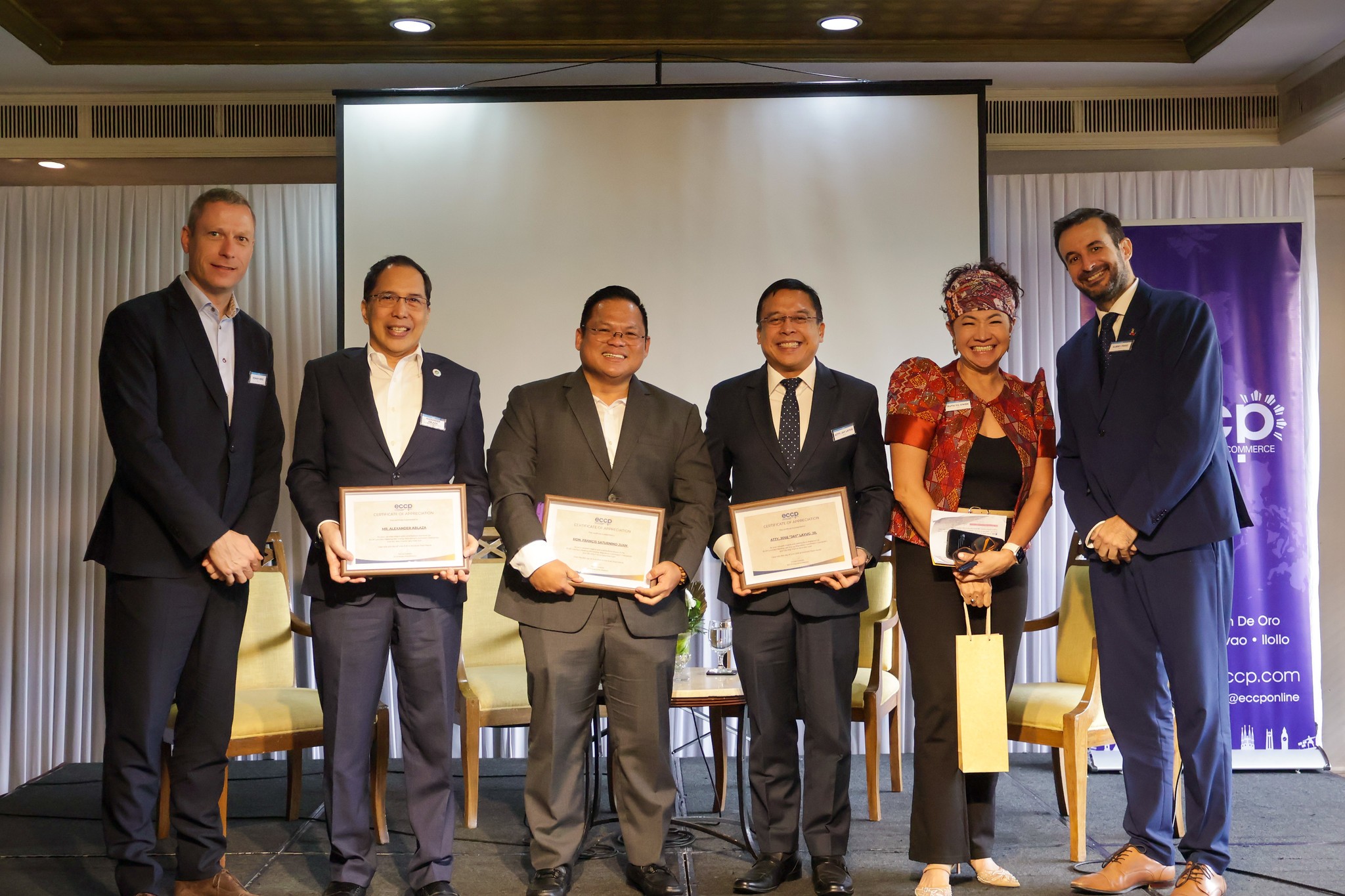
Makati City, Philippines — The European Chamber of Commerce of the Philippines (ECCP) convened its Luncheon Meeting with Energy Regulatory Commission (ERC) Chairperson and CEO Atty. Francis Saturnino Juan on 25 June 2026 at Dusit Thani Manila.
The event brought together energy industry leaders and members of the European-Philippine business community for a timely discussion on the future of the country's energy sector. It also served as a platform to discuss the Philippines' evolving energy landscape and the ERC's role in advancing energy security, accelerating the energy transition, and creating a regulatory environment that encourages long-term investments.
In his keynote presentation, Atty. Juan outlined the Commission's strategic priorities and ongoing reforms aimed at addressing longstanding challenges in the power sector while supporting the country's transition toward a more sustainable and competitive energy market.
He likewise emphasized the important contribution of European businesses to the Philippine energy sector, noting that the ERC seeks to be more than a regulator by serving as a partner in enabling the country's energy transition. According to Atty. Juan, European companies bring not only capital but also technologies, expertise, and experience from some of the world's most advanced energy markets, making their participation critical to helping the Philippines achieve its energy goals.
Navigating a Changing Global Energy Landscape
Setting the broader context, Atty. Juan remarked: "We are living through a period of genuine energy flux, and I use that word precisely. Flux does not mean breakdown. It means a rate of change whose direction is not fixed."
"Global energy markets are being reshaped simultaneously by changeable qualities, by the accelerating economics of renewable energy, and by the structural demand surge driven by electrification, electric vehicles, data centers, AI infrastructure, [and] industrial decarbonization. All of these are adding to the increasing demand at a pace that existing grids were not built to absorb," he added.
Against this global backdrop, the ERC Chairperson noted that the Philippines continues to face structural realities, including its reliance on imported coal, oil, and liquefied natural gas (LNG), making it vulnerable to movements in the global commodity market. Despite this, he underscored the country's significant renewable energy potential, stressing that the energy transition is no longer solely an environmental imperative but also an economic necessity.
"The Philippines has one of the most favorable renewable energy resource profiles in Southeast Asia. [Our] solar and electrification [are] among the highest in the region, with resources, particularly offshore, that have a very intact, disturbant capacity. That already makes us one of the world's leading producers," said Atty. Juan.
He added that increasing domestic renewable energy capacity can help reduce dependence on imported fuels, improve energy security, and strengthen the country's resilience against global market volatility.
Expanding Infrastructure for Renewable Energy
Building on this opportunity, Atty. Juan underscored the importance of strengthening the country's transmission infrastructure to support the energy transition. A major focus of the discussion was addressing transmission constraints that have slowed the integration of renewable energy projects into the grid.
He shared that the ERC recently adopted a new regulatory framework allowing qualified generation companies and other entities to finance and construct transmission facilities necessary to connect their projects to the grid. The reform, also known as ERC Resolution No. 18, Series of 2026, establishes the Implementing Rules for the Development, Ownership, and Operation of Point-to-Point Limited Transmission Facilities. It is expected to accelerate project implementation, reduce delays caused by transmission bottlenecks, and maintain safeguards that protect consumers.
Complementing these infrastructure reforms, Atty. Juan also discussed the ERC's ongoing efforts to modernize and digitalize the country's power infrastructure. He cited the Commission's Advanced Metering Infrastructure (AMI) framework, which provides distribution utilities with regulatory guidance for deploying smart metering systems, communication platforms, and grid management technologies. These initiatives are expected to improve grid efficiency, support market reforms, and create new opportunities for technology providers and investors.
Broadening Consumer Participation in the Energy Market
Atty. Juan likewise highlighted the continued expansion of the Retail Competition and Open Access (RCOA) program, which allows more businesses to directly choose their electricity suppliers. By lowering the eligibility threshold to 100 kilowatts, a significantly larger number of commercial establishments and medium-sized enterprises can now participate in the competitive electricity market and potentially access more cost-efficient and sustainable energy solutions.
To further broaden consumer participation, the ERC Chairperson shared that the Commission is actively working on the Retail Aggregation Program (RAP), a government initiative that enables smaller electricity users to pool their power demand and qualify as contestable customers. This complements the Green Energy Option Program (GEOP), which allows customers to choose electricity sourced from renewable energy by paying a premium, even while remaining within the regulated utility market. Together, these mechanisms strengthen market competition while supporting the growth of renewable energy investments.
Further advancing consumer-driven energy solutions, Atty. Juan outlined the ERC's efforts to streamline net metering processes and expand opportunities for distributed energy resources (DER), including rooftop solar, battery energy storage systems, microgrids, demand response technologies, and virtual power plants. He noted that the recent reforms have already resulted in a substantial increase in net-metering registrations, demonstrating growing consumer participation in clean energy initiatives.
"Since we streamlined the net metering process, registrations have increased by 243.56 percent. We now have 23,331 qualified end-users with a total of approximately 228,766 kilowatts peak connected to the grid. That is not a marginal improvement. That is a structural transformation in the accessibility of solar in this country," said Atty. Juan.
Enhancing Regulatory Efficiency
Turning to regulatory efficiency, Atty. Juan presented significant improvements in the ERC's processing of power supply agreements (PSAs), capital expenditure (CAPEX) applications, and regulatory issuances. He reported that under the current Commission, approvals for PSAs and CAPEX projects have increased substantially compared to previous periods, reflecting the agency's commitment to reducing bottlenecks, improving transparency, and providing greater regulatory certainty for investors.
"In the 10 months from August 2024 to May 2025, the period before the current commission, the ERC has issued pilot approvals for PSA applications in only six cases. In the comparable 10-month period under this commission, August 2025 to May 2026, we have issued 168 final approvals. That is a 28-fold increase on capital expenditure approvals… On rulemaking resolutions, we went from 14 to 35, a 115% increase. With 15 of those, 29 resolutions issued in 2026 alone," noted Atty. Juan.
Towards A Transparent, Resilient, and Future-ready Philippine Energy Sector
Following the keynote presentation, the open discussion allowed ECCP members and stakeholders to raise industry concerns and exchange insights on renewable energy integration, energy efficiency, grid modernization, digitalization, market monitoring, and regulatory reforms.
The panel discussion was moderated by Ms. Ruth Yu-Owen, President and CEO of Upgrade Energy Philippines (UGEP) and ECCP's Renewable Energy & Energy Efficiency Co-Chair. She was joined by Atty. Juan and industry experts Atty. Jose "Jay" Layug, Jr., ECCP's Renewable Energy & Energy Efficiency Co-Chair and President of the Developers of Renewable Energy for AdvanceMent (DREAM), and Mr. Alexander Ablaza, President of the Philippine Energy Efficiency Alliance.
Finally, ECCP Treasurer Alber Perez underscored the importance of sustained public-private dialogue in achieving the country's energy objectives and fostering an environment conducive to investment and innovation.
The luncheon meeting reaffirmed the shared commitment of the ECCP, the ERC, and industry stakeholders to strengthening cooperation in support of a transparent, resilient, and future-ready Philippine energy sector. As the country continues to navigate its energy transition, constructive engagement between regulators and the business community remains essential to ensuring long-term energy security, sustainability, and economic growth.
The ECCP's Luncheon Meeting was made possible through the support of Advocacy Partner Philippine Energy Efficiency Alliance, Inc. (PE2) and Table Top Partner MPower.



Serving the European-Philippine business community since 1978, the ECCP remains committed to enabling cross-sector collaboration, promoting economic growth, and championing a sustainable future. For inquiries or further information, you may contact us directly or connect with us through our official social media channels.