
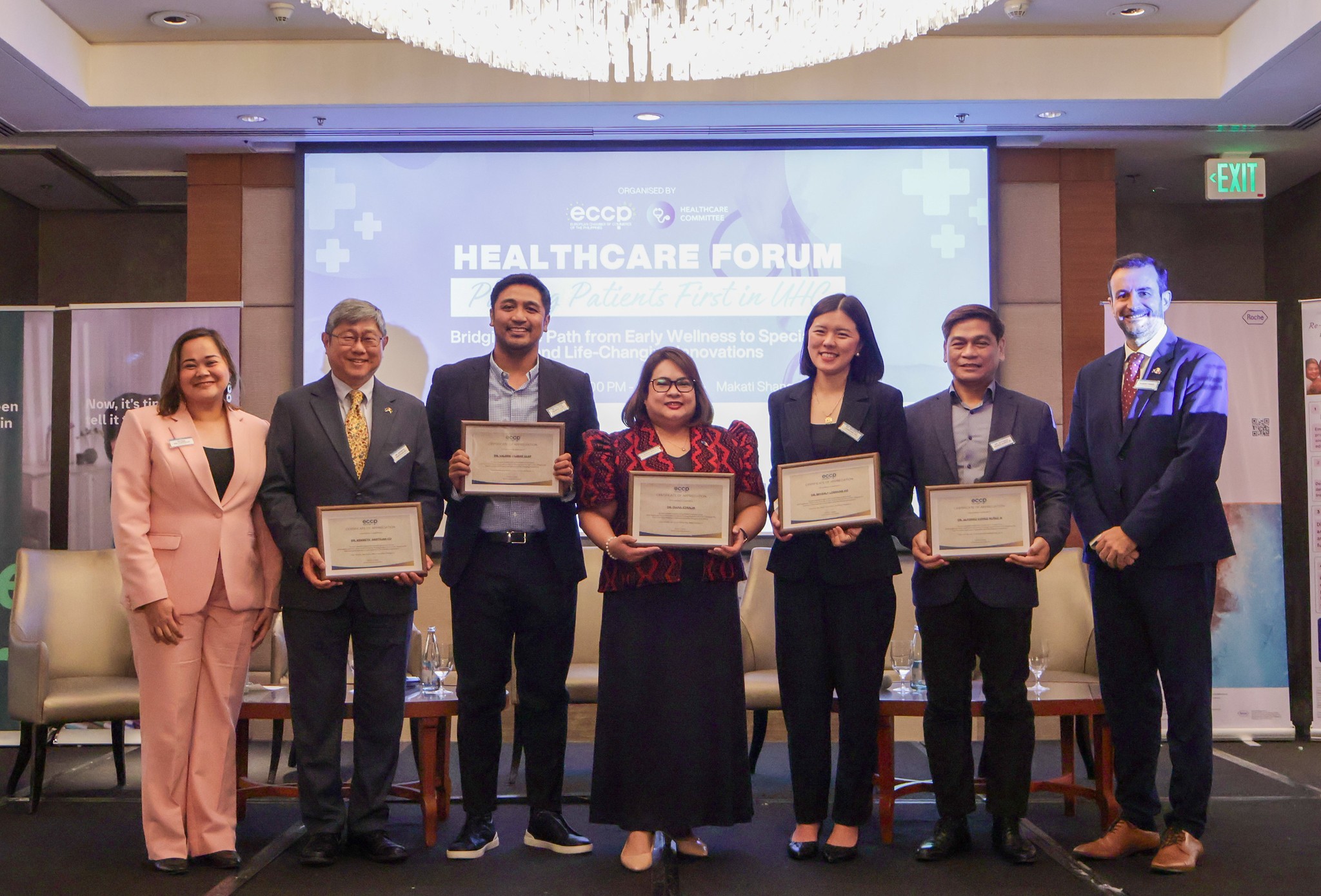
Makati City, Philippines — Reinforcing the importance of patient-centered Universal Health Care (UHC), the European Chamber of Commerce of the Philippines (ECCP) held its 2026 Healthcare Forum on 18 June 2026 at the Makati Shangri-La Hotel.
Centered on the theme, “Putting Patients First in UHC: Bridging the Path from Early Wellness to Specialized and Life-Changing Innovations,” the forum brought together leaders and advocates from the government, healthcare institutions, and private sector to explore collaborative solutions for improving healthcare access and outcomes in the Philippines.
Building a More Connected Healthcare Journey
During the forum, speakers highlighted international best practices in UHC implementation, the value of early intervention, and strategies for creating seamless referral pathways from primary care facilities to specialized treatment centers.
ECCP President Dr. Diana Edralin emphasized that the success of UHC should be measured not only through statistics and coverage targets, but by the quality of the patient’s experience. She noted that true UHC means ensuring every Filipino can navigate a seamless and dignified healthcare journey starting from preventive wellness checks to specialized treatment at apex hospitals.
“We cannot discuss a patient-centric health system without addressing the reality on the ground that we all face everyday,” said Dr. Edralin.
“In the Philippines, a common complaint that arises is that the patient journey is too fragmented and too difficult to navigate. When a gap exists between an early screening and a tertiary referral, it is the patient who pays the price in time, in financial hardship, and in the unfortunate outcomes because of the delays,” she added.
Echoing the need for stronger primary care systems, Dr. Valerie Gilbert T. Ulep, Senior Research Fellow at the Philippine Institute for Development Studies (PIDS), also noted that nearly 30% of hospital admissions in the Philippines could be avoided through stronger front-line care. He added that an estimated Php 23–30 billion in PhilHealth reimbursements are attributed to Ambulatory Care Sensitive Conditions (ACSC), and highlighted that out-of-pocket (OOP) spending in the Philippines remains alarmingly high at around 40% of total health expenditures, well above upper middle-income peers and neighboring countries like Vietnam, Malaysia, Indonesia, and Thailand.
This heavy reliance on OOP payments undermines financial protection, leaving households highly vulnerable to the economic shocks of illness. To address this, Dr. Ulep stressed that reducing OOP spending requires stronger public financing mechanisms and strategic health reforms, mirroring OECD countries that successfully transitioned away from user-fee dependent systems.
These insights underscore the importance of strengthening primary care, improving care coordination, and sustaining investments in health system reforms to ensure that we move toward a more integrated and connected system that enables patients to access the right care at the right time.
Removing Barriers to Access and Innovation
Building on discussions about the patient journey, the forum also explored how patients can gain faster access to medicines and innovative treatments. Speakers emphasized the need to strengthen regulatory processes, reduce delays in access, and enhance health financing mechanisms to support a more responsive healthcare ecosystem.
“Patients in rural communities face greater barriers… When access depends on privilege rather than need, UHC remains unrealized,” shared Ms. Araceli S. Lanorio, Board Secretary of the Philippine Alliance of Patient Organizations. She stressed that addressing inequities in access requires sustained efforts to bring essential health services closer to patients, especially in geographically isolated areas and underserved communities.
Additionally, Dr. Herdee Luna, Oncology Manager at the Philippine Cancer Society, highlighted that “Without access and funding, patients fall into the cracks and abandon life-saving treatment courses,” resulting in a “double burden” for both patients and the healthcare system.
On one hand, emphasizing the role of policy and regulation in improving healthcare access, Dra. Irene F. Fariñas, Director General of the Food and Drug Administration (FDA), highlighted the agency’s ongoing efforts to address regulatory backlogs through strengthened human resources, process improvements, and digital transformation initiatives. As part of these reforms, she underscored the FDA’s progress in adopting the reliance pathway and implementing risk-based evaluation approaches, enabling the agency to leverage assessments from trusted international regulators to accelerate the evaluation and approval of health products while upholding standards of safety, efficacy, and quality.
Dr. Fariñas stressed that strong, science-based regulation remains fundamental to building public trust, improving access to innovation, and advancing the goals of Universal Health Care.
In addition, and aligned with the ECCP’s long-standing advocacy for regulatory efficiency, Dr. Jaime C. Montoya Mantaring likewise highlighted ongoing initiatives to further institutionalize and expand the use of reliance pathways, recognizing their potential to accelerate patient access to innovative medicines and healthcare technologies.
Scaling Local Solutions for Lasting Impact
The forum concluded with discussions on the role of community-based health programs and public-private partnerships in driving healthcare transformation. Drawing from successful local initiatives, speakers of the forum shared insights on scalable approaches that can expand access to care, strengthen disease prevention efforts, and support the long-term goals of Universal Health Care across communities nationwide.
For instance, Dr. Marlon Molano, City Medical Coordinator for Health Education and Promotions of Quezon City, highlighted the city’s comprehensive, system-based approach to primary care mental health, implemented through multiple LGU-level programs anchored on the Quezon City Mental Health Code of 2022.
He shared that Quezon City proactively developed its own framework in 2015, building services across community, youth, workplace, and crisis intervention settings, supported by trained health workers, wellness hubs, and a mental health hotline that has served over 1,800 individuals.
Emphasizing that effective mental health interventions stem from coordinated systems rather than isolated efforts, he underscored the importance of sustained investment, multi-sectoral partnerships, and stronger national support mechanisms such as PhilHealth benefit packages.
In line with this, Dr. Maria Greta Cortez, Head of Medicine at Boehringer Ingelheim Philippines, stated that community-based public–private partnerships (PPPs) are helping bridge system weaknesses by bringing care closer to patients and strengthening coordination across stakeholders, as seen in models like Iwas Dialysis and Ligtas Kidneys for chronic kidney disease. While not a complete solution, PPPs— supported by strong LGU ownership, clear roles, data-driven design, and adaptability — can enhance early detection, improve continuity of care, and support more effective Universal Health Care implementation.
Driving Collective Action for Better Health Outcomes
Throughout the forum, a clear message emerged: achieving true Universal Health Care is a vital priority that calls for timely, decisive action. The ECCP encourages both the public and private sectors to further increase investments in the country's healthcare financing and digitalization. To bridge existing gaps, we look forward to swift, deliberate interagency collaboration that helps break down administrative silos and prioritizes the patient journey.
Furthermore, the Chamber highlights the importance of establishing more predictable, transparent regulatory frameworks that align with global standards. Crucially, we support the institutionalization and accelerated use of reliance pathways. Timely progress is essential, as delays in policy and modernization can directly impact the care delivered to Filipino patients. The ECCP reaffirms its unwavering commitment to leading this public-private collaboration, ensuring that the promise of Universal Health Care becomes an immediate reality for all.
The 2026 Healthcare Forum is supported by Embassy Partners: Austrian Embassy in Manila, Embassy of the Federal Republic of Germany in Manila; Embassy of Romania in the Philippines; Embassy of Ukraine in the Republic of the Philippines; Industry Partners: Healthcare Technology of the Philippines (HTAP); Philippine Alliance of Patient Organizations (PAPO); Pharmaceutical and Healthcare Association of the Philippines (PHAP); Philippine Cancer Society; and UHC Watch; Co-Presenters: Boehringer Ingelheim (Philippines) Inc. and Roche Philippines; Advocacy Partner: Ayala Healthcare Holdings, Inc. (AC Health); Table Top Partner: B. Braun Medical Supplies, Inc.; and Media Partners: iMPACT, the Philippine Daily Inquirer, Inquirer.Net, Inquirer Lifestyle, Radyo CSR, and The Manila Times.


Serving the European-Philippine business community since 1978, the ECCP remains committed to enabling cross-sector collaboration, promoting economic growth, and championing a sustainable future. For inquiries or further information, you may contact us directly or connect with us through our official social media channels.