
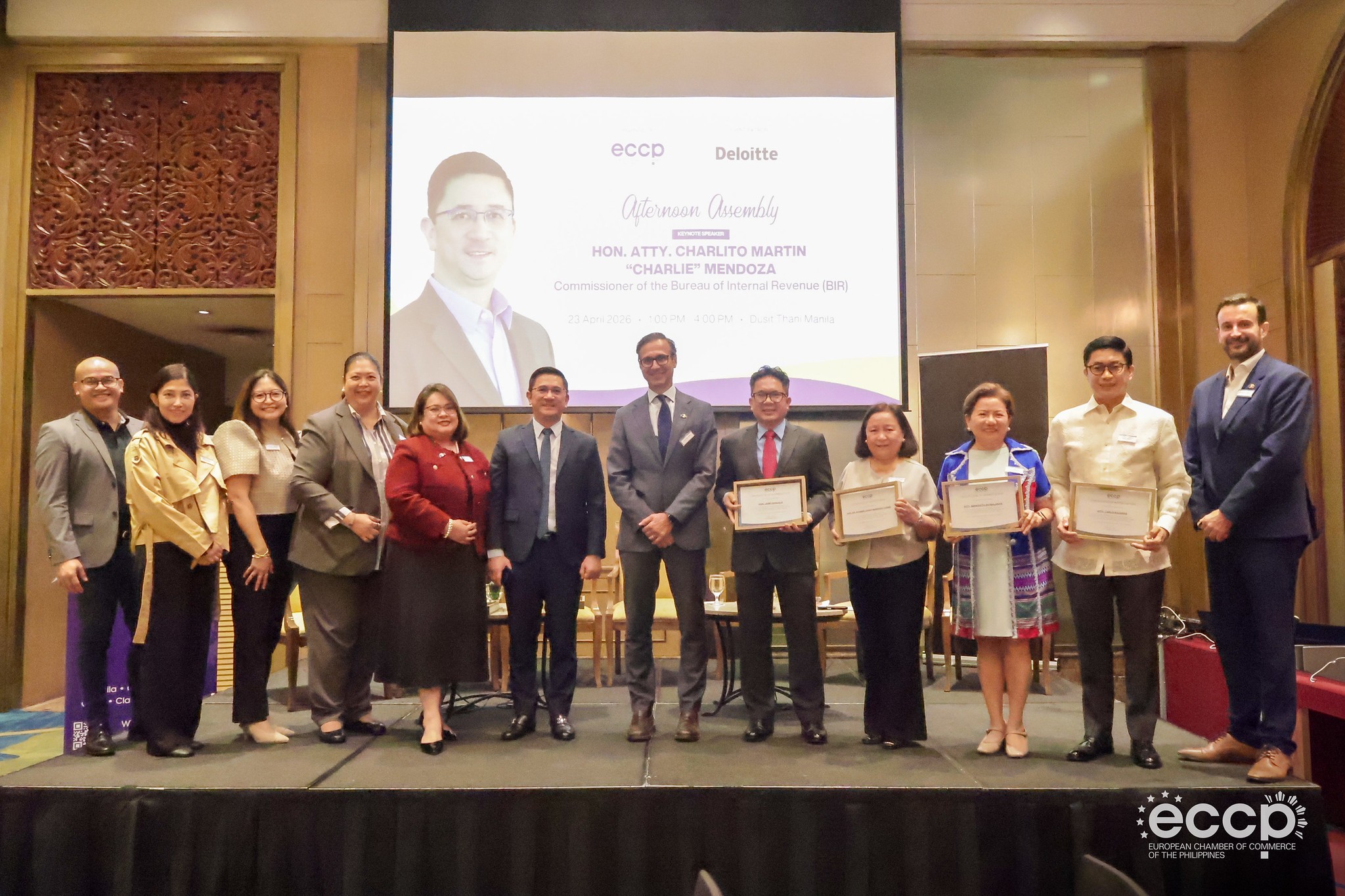
Makati City, Philippines - On 23 April 2026, the European Chamber of Commerce of the Philippines (ECCP), in partnership with Deloitte Philippines, convened a high-level dialogue with Bureau of Internal Revenue (BIR) Commissioner Atty. Charlito Martin “Charlie” Mendoza, bringing together leaders from government, the private sector, and the tax community to advance discussions on tax reform, digitalization, and improving the ease of doing business in the country.
Held at Dusit Thani Manila, the Afternoon Assembly provided a platform for candid and constructive engagement on how ongoing reforms can translate into more efficient, transparent, and predictable tax administration.
In his opening remarks, ECCP President Paulo Duarte underscored the importance of consistency and reliability in tax administration, noting that investor confidence is shaped not only by policy, but by how it is implemented in practice.
“For companies operating in the Philippines, what matters is not only the policy itself, but how it is applied day to day. Businesses need clarity, consistency, and predictability—not as a luxury, but as a baseline for long-term planning and growth,” Duarte said.
He emphasized that while attracting new investments remains a priority, the experience of companies already operating in the country sends a stronger and more credible signal to future investors.
“How the Philippines treats businesses that have already placed their bet on this country tells future investors far more than any roadshow ever could,” he added.
BIR Outlines Reform Agenda Under DARES Framework
Commissioner Mendoza presented the BIR’s five-pillar reform agenda, known as DARES—Digital and Data Transformation, Audit Reform and Accountability, Revenue Collection and Base Protection, Employee Empowerment and Welfare Promotion, and Service Excellence and Stakeholder Engagement.
He highlighted early progress in 2026, including the rollout of digital tools aimed at improving taxpayer experience, enhancing compliance, and strengthening transparency. These include the rollout of the system-assisted audit selection framework, LOA Verifier, Interactive Digital Tax Calendar, QR Code Verifier for Certificates of Registration, and the Revenue Monitoring and Intelligence Dashboard (ReMIND).
“Excellent service worthy of your taxes is not just a campaign line—it is what the Bureau must now prove through actual work: better systems, clearer rules, and reforms that taxpayers can feel,” Mendoza said.
Private Sector Perspectives: From Policy to Practice
The Assembly’s panel discussion reinforced a central theme across industries: what matters is not only policy design, but consistent and practical implementation. Participants welcomed the direction of reforms while raising key priorities, including: stronger integration and reliability of digital systems; clearer guidelines and timelines for e-invoicing implementation; improved consistency in audit practices and interpretation across revenue offices; and more definitive guidance for sector-specific tax treatments, particularly in emerging industries such as digital services and renewable energy.
These concerns reflect the day-to-day realities faced by businesses and underscore the importance of ensuring that reforms translate into tangible improvements on the ground.
Open Forum Highlights
A key highlight of the Assembly was the open forum, where participants engaged directly with BIR leadership on operational challenges and reform priorities—demonstrating a shared commitment to constructive dialogue.
Key issues raised included: system reliability and integration, particularly during peak filing periods and across e-filing, payment, and invoicing platforms; consistency in audit implementation, including varying interpretations across revenue district offices and the need for clearer, centralized guidance; e-invoicing readiness, with calls for clearer timelines, onboarding criteria, and safeguards on data security; sector-specific concerns, particularly in digital services and renewable energy, where gaps in guidance create uncertainty and uneven application; and revenue targets and audit pressure, with stakeholders seeking assurance that compliance efforts would not disproportionately burden already highly compliant taxpayers.
Participants also highlighted the need to update tax frameworks to reflect the realities of the digital economy, noting that current rules are often applied to business models that were not contemplated when existing laws were crafted.
In response, BIR officials outlined ongoing and planned measures, including: the rollout of system-assisted audit selection and anonymized case assignments to improve fairness and reduce discretion; the development and updating of industry-based audit guidelines; efforts to simplify withholding tax rates; continued expansion of digital platforms and taxpayer-facing systems; and openness to multi-sectoral consultations and technical working groups, particularly on emerging areas such as digital taxation and e-invoicing.
Commissioner Mendoza reaffirmed the Bureau’s commitment to a balanced, service-oriented approach.
“We will not squeeze our taxpayers. Our goal is to collect what is properly due, while making it easier for taxpayers to comply and understand the rules.”
Advancing a More Competitive Business Environment
The dialogue reflects ECCP’s continued role as a bridge between the private sector and government, ensuring that policy reforms are informed by real business experience.
As both sectors navigate a rapidly evolving economic and digital landscape, the ECCP emphasized that sustained collaboration will be key to ensuring that reforms are effectively implemented, consistent in application, and responsive to the needs of businesses.
Through engagements such as this, the ECCP remains committed to supporting reforms that enhance transparency and efficiency; strengthen investor confidence; and position the Philippines as a more competitive and predictable place to do business.
ECCP leaders attended the event, including President Paulo Duarte and Vice-Presidents Dr. Diana Edralin and Albert Perez. They were joined by ECCP Tax and Financial Services Committee Chairwomen Atty. Maria Concepcion Simundac-Delos Santos and Atty. Benedicta Du-Baladad, alongside Deloitte Philippines’ Tax and Legal Leader and Transfer Pricing Leader, Atty. Carlo Navarro.
Also in attendance were BIR representatives: Atty. Larry M. Barcelo, Deputy Commissioner of the Legal Group; Atty. Marissa O. Cabreros, Deputy Commissioner of the Strategic Reform Group; and Atty. Ma. Rosario Charo Enriquez-Curiba, Deputy Commissioner of the Information Systems Group. The Assembly was hosted by Atty. Alden C. Labaguis, Vice Chair of the ECCP Tax and Financial Services Committee, as well as the Customs and Logistics Committee.


Serving the European-Philippine business community since 1978, the ECCP remains committed to enabling cross-sector collaboration, promoting economic growth, and championing a sustainable future. For inquiries or further information, you may contact us directly or connect with us through our official social media channels.